




























Still Thinking Of Assignment Help & Grades ? Book Your Assignment At The Lowest Price Now & Secure Higher Grades! CALL US +91-9872003804

Public Law Assignment Help

assignment

Assignment

achievement

Achievement

hire-experts

Hire Experts

testimonials

Reviews

free-services

Free Services

grades-delivered

Grades

samples

Samples

offers

Offers

order-now

Order Now

Law can be divided into two categories namely public law and private law. This article is focused on the aspect of the law that is public in nature. Public law is also known as the public act or public statute is a branch of law that is concerned about various laws like constitutional law, administrative law, tax law, procedural law and criminal law. What is the scope of public law?  Public law has the followi..... .....

Our Achievements

50,000+

Orders Delivered

4.9/5.0

Star Rating

100%

on-time delivery

24 x 7

Query Resolution

100 +

Subjects Catered

Our Experts

Free Assignment Services

Title Pages - 100 Words

$05.00 free

Downloading Free Guide

$20.00 free

Upload Completed Tasks

$20.00 free

Genuine Content Report

$20.00 free

Consultation By Experts

$06.00 free

Unrestricted Revisions

$10.00 free

Grammar Check for Task

$25.00 free

Plagiarism Inspections

$25.00 free

Book Now and get Free Services Upto $0.00

Public Law Assignment Help Sample

Public Law Assignment Help Sample by VAH Experts

C10125 Updated on : Feb 2026

Explain the concept of 'negligence' in Australian business law. Discuss the elements that must be proven for a successful negligence claim, and provide an example of how negligence might arise in a business context.

Introduction
Negligence is a fundamental concept in Australian tort law, which holds individuals or businesses accountable for failing to exercise reasonable care, resulting in harm to another party. In a business context, negligence can arise in various situations, such as workplace accidents, defective products, or professional malpractice. To establish a successful negligence claim, the plaintiff must prove four key elements: duty of care, breach of duty, causation, and damage.


1. Duty of Care
The first element of negligence is establishing that the defendant owed the plaintiff a duty of care. In Australian law, this is determined by the "neighbour principle" established in Donoghue v Stevenson [1932] and later refined in Caparo Industries plc v Dickman [1990]. A duty of care exists when it is reasonably foreseeable that the defendant’s actions could harm the plaintiff. For example, a business owes a duty of care to its employees to provide a safe working environment.


2. Breach of Duty
The plaintiff must prove that the defendant breached their duty of care by failing to act as a reasonable person would in similar circumstances. This is assessed objectively, considering factors such as the likelihood of harm, the severity of potential harm, and the cost of preventing the risk. For instance, if a business fails to maintain equipment, leading to an employee’s injury, this could constitute a breach of duty.


3. Causation
Causation requires the plaintiff to demonstrate that the defendant’s breach directly caused the harm suffered. This involves both factual causation (the "but for" test) and legal causation (whether the harm was within the scope of liability). In March v Stramare [1991], the High Court of Australia emphasized that causation is a practical question of fact. For example, if a customer slips on a wet floor in a store due to a lack of warning signs, the store’s negligence is the direct cause of the injury.


4. Damage
Finally, the plaintiff must show that they suffered actual damage or loss as a result of the defendant’s breach. This can include physical injury, financial loss, or property damage. In a business context, this could involve a customer suing for injuries caused by a defective product.


Example of Negligence in a Business Context
A common example of negligence in business is a workplace accident. Suppose an employee is injured while operating machinery that was not properly maintained by their employer. The employer owed a duty of care to the employee, breached that duty by failing to maintain the machinery, and this breach directly caused the employee’s injury. The employee could successfully sue the employer for negligence.


Conclusion
Negligence is a critical area of Australian business law, ensuring that businesses act responsibly to prevent harm to others. Businesses can mitigate risks and avoid legal liability by understanding the four elements of negligence—duty of care, breach, causation, and damage. Failure to adhere to these principles can result in significant financial and reputational consequences.


Public Law Assignment Help Sample by VAH Experts

BLW902 Updated on : Feb 2026

Corporate Veil and Its Exceptions: A Comparative Analysis

Introduction: The corporate veil separates a company from its shareholders, protecting them from personal liability. However, courts may lift the veil in cases of fraud, injustice, or abuse of corporate personality.

The Doctrine of the Corporate Veil: The principle is rooted in the landmark case of Salomon v A Salomon & Co Ltd (1897), which established the separate legal personality of a corporation.

Key Judicial Precedents

Salomon v A Salomon & Co Ltd (1897) – Established corporate personality.
Adams v Cape Industries plc (1990) – Reinforced the principle but acknowledged exceptions.
Prest v Petrodel Resources Ltd (2013) – Clarified when courts may lift the veil.

Exceptions to the Corporate Veil

Fraud or Sham Companies: Courts may disregard the corporate structure if used to commit fraud (Gilford Motor Co Ltd v Horne).
Agency Relationships: Where a company acts as an agent for its shareholders.
Public Policy and Statutory Provisions: Various laws allow piercing the veil in specific circumstances.

Comparative Analysis: UK, USA, and Australia

UK: Strict approach with limited exceptions.
USA: More flexible, especially in cases of undercapitalization and corporate mismanagement.
Australia: Courts adopt a middle-ground approach, balancing corporate autonomy with equitable considerations.

Conclusion: While the corporate veil is a vital principle, exceptions ensure accountability and prevent misuse. Jurisdictions differ in their willingness to lift the veil, reflecting varying legal traditions and policy concerns.

References
Gower, L. C. B. (2019). Principles of Modern Company Law.
Bainbridge, S. M. (2018). Corporate Law.

Public Law Assignment Help Sample by VAH Experts

BLW901 Updated on : Feb 2026

The Doctrine of Consideration in Contract Law: A Critical Analysis

Introduction The doctrine of consideration is a fundamental principle in contract law that ensures reciprocity in contractual agreements. It acts as a mechanism to determine the enforceability of promises. However, its rigid application has been criticized, leading to reforms and exceptions across different jurisdictions.

The Role of Consideration in Contract Law Consideration is defined as something of value exchanged between parties in a contract. It can take various forms, including money, goods, services, or forbearance. The doctrine is rooted in common law traditions and is essential in determining the validity of contracts.

Key Case Laws

Currie v Misa (1875) - Established that consideration must have some economic value.
Chappell & Co Ltd v Nestlé Co Ltd (1960) - Demonstrated that consideration need not be adequate but must be sufficient.
Williams v Roffey Bros & Nicholls (Contractors) Ltd (1991) - Highlighted the practical benefit as a valid form of consideration.

Exceptions to Consideration

Promissory Estoppel: As seen in Central London Property Trust Ltd v High Trees House Ltd (1947), consideration may be waived under equitable principles.
Contracts under Seal: Certain agreements do not require consideration if executed as deeds.
Past Consideration in Some Jurisdictions: Some exceptions exist where past consideration is recognized.
Contemporary Criticisms The rigidity of the doctrine has been challenged due to its limitations in enforcing moral obligations and evolving commercial practices. Jurisdictions like the USA have adopted more flexible approaches, such as the doctrine of promissory estoppel.

Comparative Analysis: UK, USA, and Australia

UK: Strict adherence to the requirement of consideration.
USA: Greater reliance on promissory estoppel.
Australia: Consideration remains a requirement, but equitable principles play a more significant role.

Conclusion: The doctrine of consideration remains a cornerstone of contract law but requires flexibility to accommodate modern commercial realities. Reforms and judicial adaptations continue to shape its application in different legal systems.

References
Poole, J. (2020). Textbook on Contract Law.
Smith, S. A. (2004). Contract Theory.

Public Law Assignment Help Sample by VAH Experts

LAWS2708 Updated on : Feb 2026

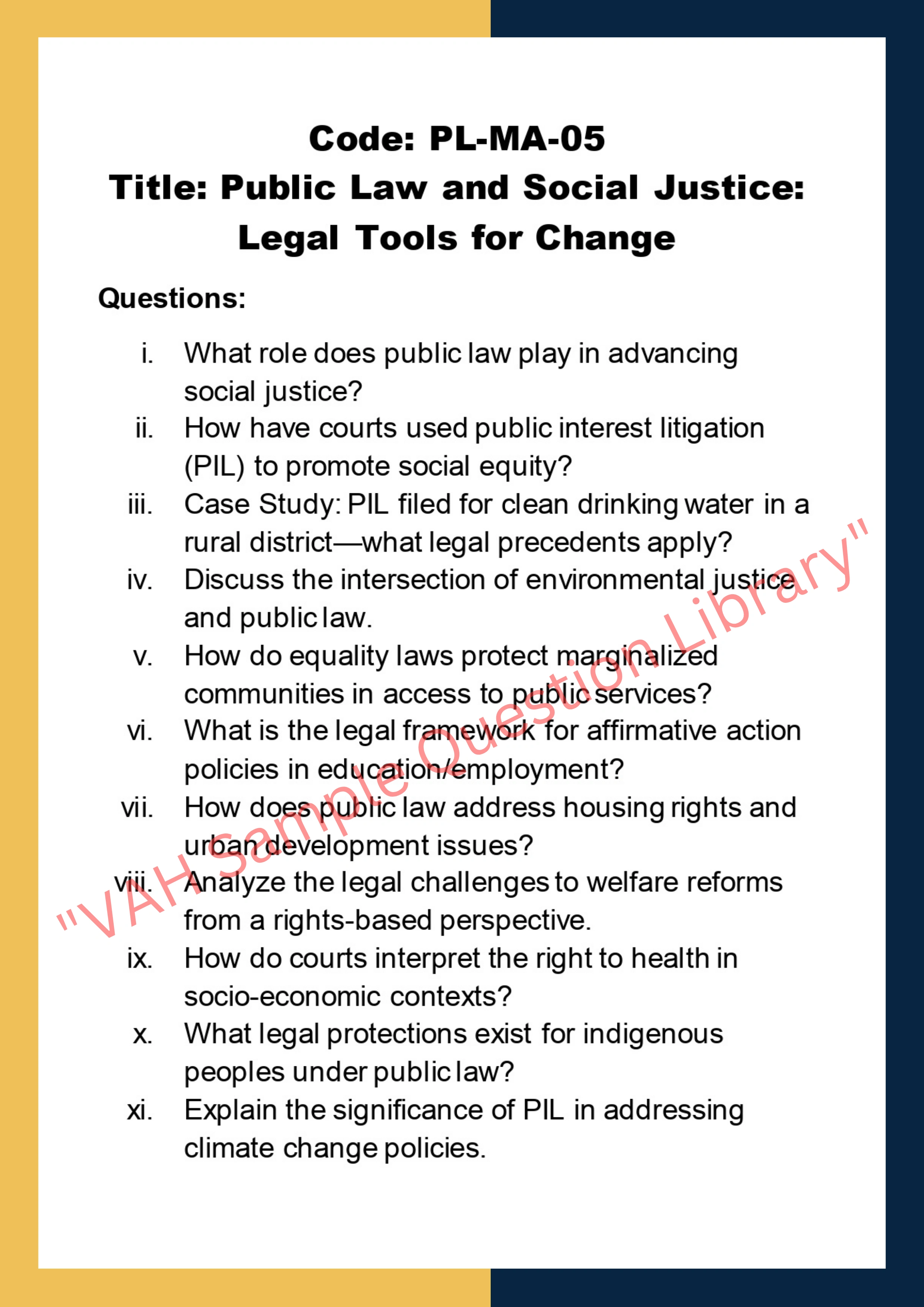
What are the responsibilities of a police criminal intelligence investigator?

In law enforcement, "intelligence" refers to top-secret, covert operations. In fact, "intelligence" is just another word for "information". Police agents who assemble intelligence to study and solve crimes are called "tactical intelligence". Members of the Central Intelligence Agency collect intelligence through covert operations and covert work. These investigators usually work for local police departments and federal agencies.

Public Law Assignment Help Sample by VAH Experts

Updated on : Feb 2026

What is a criminal offence?

A civil wrong is distinct from a crime because it does not disrupt the moral standards of society to the same extent. While these claims include "false," they have not considered a moral failure in the same way criminal offenses are. Therefore, in its broadest definition, a criminal offense is a behavior that is prohibited by law and supposed to violate the moral standards of society.

Public Law Assignment Help Sample by VAH Experts

Updated on : Feb 2026

What is the criminal justice system, and why is criminal justice important?

The criminal justice system is an organization that touches upon law and order in society. As an individual, you can be exposed to the criminal justice system in several ways. For example, if you contact a cop on the street, you are exposed to the criminal justice system. In addition, you have been exposed to the criminal justice system if you are called to jury duty.

Public Law Assignment Help Sample by VAH Experts

LAWS5215 Updated on : Feb 2026

Explains the various jurisdictions of a civil court under the Code of Civil Procedure.

Jurisdiction is the practical authority given to a formally constituted legal body or a political leader to deal with and declare legal matters, and by implication, to administer justice within a defined area of ​​responsibility. The term also denotes the geographical area or subject matter to which such authority applies.

Public Law Assignment Help Sample by VAH Experts

Updated on : Feb 2026

What are the elements and stages of a crime?

Criminal law is a body of rules and statutes that defines conduct prohibited by the state. It frightens and harms public safety and welfare and establishes punishments for the commission of such acts. Criminal law varies from civil law in that the emphasis is on dispute resolution rather than punishment. The term criminal law generally refers to existing criminal laws. Adequate criminal laws define offenses and prescribe punishments.


Public Law Assignment Help Sample by VAH Experts

Updated on : Feb 2026

What is an inquisitorial Process in the Criminal Justice Process?

The inquisitorial process is essential in the criminal justice system. Typically, the criminal defense advocates a reasonable suspicion that their client has not committed a crime. The prosecution is trying to prove the guilt. It describes adverse processes.

Curative procedures allow the judge to play a role in the prosecution or defense of a client, rather than merely presiding over the court process and pronouncing a sentence.

Public Law Assignment Help Sample by VAH Experts

LAW1504 Updated on : Feb 2026

What do you understand by Administrative Law?

Administrative law is the law that manages administrative functions. According to Ivor Jennings- Administrative law is the law related to administration. It prescribes the organization, powers, and duties of the administrative officers. It includes laws relating to the rule-making power of administrative bodies, quasi-judicial functions of administrative agencies, legal obligations of public authorities, and general courts' power to supervise administrative officers. It controls the executive and ensures that the executive treats the public fairly.

Public Law Assignment Help Sample by VAH Experts

Updated on : Feb 2026

Explain the role of Judges in shaping Law.

Judges and advocates are known as safeguards of the law. They are the ones who have always maintained the dignity of the law. The word 'rule of law' is derived from the French phrase 'la principle de validate, which means 'the principle of validity'. The rule of law lays down three critical principles, i.e. supremacy of law, equal protection of law, and equality before the law. 

Public Law Assignment Help Sample by VAH Experts

Updated on : Feb 2026

Explain the meaning and nature of public law.

Public law is that part of the law, which governs the relationship between the state (government/government agencies) with its subject and between individuals directly related to society. According to Loughlin, 'Public law is a form of political jurisprudence that does not involve any transcendental or metaphysical notions of justice and goodness; it is only related to Rules of conduct developed through political exercise to ensure the maintenance of the public sector as an autonomous entity.'

Public Law Assignment Help Sample by VAH Experts

LAWS1001 Updated on : Feb 2026

Who can make statutory laws?

Statutory legislation can be made at all levels of government; it can come from the state, federal and even local governments. A government can make a law applicable within its jurisdiction and at lower levels of government. For example, the federal government may create a relevant law throughout the United States. States can make laws that will apply only to their states.


Public Law Assignment Help Sample by VAH Experts

Updated on : Feb 2026

How do courts interpret statutory law?

When courts begin to understand a law, they begin by looking at the simple language of the law. If the law is sharp and well-defined, the courts draw closer to the point that the law means what it says. Courts recognize that the legislature wants to give meaning to every word of the law. They deny the idea that the legislature may have put anything they do not mean in different words.

Public Law Assignment Help Sample by VAH Experts

Updated on : Feb 2026

What is statutory law, and what is its purpose?

Laws are rules passed by a controlling authority that have binding legal force and, if not followed, lead to penalties. Their goal is to promote justice and prevent harm. When all the laws are taken together, they are collectively known as statutory laws. In addition, the laws are intended to promote justice and prevent harm. In other words, laws are not meant to encourage the good.

Exclusive Deals

Our Special Offers

✦ Special Offer 01
Valued Deals Offer
100
Percent OFF on your order
Book any 6 Assignments within 7 days get 7th assignment FREE
Conditions and restrictions apply.
✦ Special Offer 02
SIMILAR ORDER OFFER
100
Percent OFF on your order
Book 4 Similar Assignments within 3 days get 1 more copy 100% FREE
Conditions and restrictions apply.
✦ Special Offer 03
UPTO
30
Percent OFF on your order
Book 3 assignments within 72 hours & get 30% OFF
Conditions and restrictions apply.
✦ Special Offer 04
UPTO
50
Percent OFF on your order
Book 2 Assignment within 48 hours, get 50% OFF on assignment
Conditions and restrictions apply.
✦ Special Offer 05
Grab Your First Assignment
30
Flat OFF on your order
Grab Your First Assignment
Conditions and restrictions apply.
✦ Special Offer 06
Month-End Offer
10
Flat OFF on your order
Month-End Offer for home page hero section
Conditions and restrictions apply.
✦ Special Offer 07
just @ $14
14
Flat OFF on your order
this is for  home page just @ $14 div
Conditions and restrictions apply.
✦ Special Offer 08
just @ $6
6
Flat OFF on your order
this is for  home page just @ $6 div
Conditions and restrictions apply.
✦ Special Offer 09
just @ $9
9
Flat OFF on your order
this is for  home page just @ $9 div
Conditions and restrictions apply.

How Value Assignment Help Works.

Icon

1. PLACE YOUR ORDER

Whenever you fill out their order form, please read it carefully and then fill it out.

Icon

2. MAKE PAYMENT

Choose our secure payment method to pay for your order and collect your order from us with security.

Icon

3. GET YOUR DOCUMENT

Our writers write you plagiarism-free assignments and provide them to you before the deadline.

Get Your Assignment

In order to use this service, you have to complete this process

  • Basic Details
  • Process
  • Upload Files

Setup your Account

Enter Your Basic Details
Please Enter Name
Please Enter Email
Please Enter Phone Number

Select Other Deatils

Please Select Refrencing style
Please Select Subject
Please Select Deadline

Upload Files

Please Upload only PDF,JPG,PNG And DOC Files..
Please Select File

Get Free Price Quote

Today's Offer! Expert Assignment Help at $6/page

25% off

Loading...
Assignment help price

Grab Deals

Public Law Assignment Help

Law can be divided into two categories namely public law and private law.

This article is focused on the aspect of the law that is public in nature.

Public law is also known as the public act or public statute is a branch of law that is concerned about various laws like constitutional law, administrative law, tax law, procedural law and criminal law.

What is the scope of public law? 

Public law has the following areas of scope:

  • It focuses on the government organization

  • It maintains the relationship between a state and its citizens

  • It enumerates and evaluates government officials’ responsibilities

  • It focuses on the relationship that is present between sister states.

What is the main purpose of public law?

The main purpose of public law is to set up rules in regards to the relationship that is present between a person and the society at large as well as the role of the different and various government levels.

What are the branches of public law?

The main branches of public law are:

  • Criminal law

  • Constitutional law

  • Administrative law

What is the importance of public law?

Public law generally deals with social problems and is believed to have been evolved through political practice in order to make sure that the public realm maintenance is continued as an autonomous entity.

The study of public law entails rigorous hard-work and persistence. The students who opt for a career in public law often have to go through a lifestyle involving maximum hours of studying and understanding the concepts and sections of public law.

As public law is a vast subject, it also means that the number of assignments that a student has to complete within the course of their study are very high.

A student may find it difficult to complete all their assignments on time as they may have simultaneous submissions, or they do not have enough time to complete on the assignments as they are busy studying or working or doing some important work, or they find it difficult to attempt the questions due to lack of concept clarity or maybe they are good at a particular subject and not that good in another one. For example, a student may be great at criminal law and its understanding but not be that good at understanding and attempting the concepts of tax law.

In any of the above cases or for any other reason, a student may develop the need to undertake assignment help. Assignment help is like a help provided by a tuition teacher who not only helps to complete an assignment but also provides concept clarity to their students.

We at VAH are such tuition teachers only. Our range of experts from across the world have PhD qualifications in over 100 subjects and have an experience of over a decade in providing assignment help.

They not only help you with the completion of your assignment in a professional way while keeping the rubric in mind, but also make sure that it is submitted on time after doing any number of revisions that you might require.

Our experts make sure that a last-minute assignment is as good in terms of quality as an assignment that has been assigned for over a week and our count of over a million and counting happy and satisfied users validate the level of quality that we deliver.

Therefore, for any assistance that you require to complete your assignments, you are free to contact VAH at our online portal which in addition to our experts is available for use 24*7. 

Discounts on Public Law assignments for first-time users

We offer a special discount to all new customers of our assignment help service. Whether you're ordering a legal essay, case study analysis, or public law assignment help, our aim is to deliver quality support. For a new customer, a flat 30% discount rate is applied. For the best offers, connect with our live customer support team and find out our latest offers and discounts. Don’t miss out. Our live customer support might be giving away free assignments as well!

Free revision policy for Public Law assignments

We take utmost care of your assignment from the start itself and make sure everything is written according to your needs. But if you still feel like you are not satisfied with our work or need to make changes in your assignment, then you can just contact our customer service, and we will provide you with free unlimited revisions until you feel satisfied with our work.

Can you assist with legal case briefs or critical analysis in Public Law?

Mastering Public Law Key Areas

Absolutely! Our experts are proficient in writing and analysing different legal cases and administrative procedures as well. Here are some of the topics that are covered by our experts in public law assignments-

  1. Constitutional interpretation 

  2. Judicial reviews 

  3. Policy critiques

  4. Supreme Court legal cases 

 We deliver accurate, clear, and well-structured legal analyses tailored to your academic level. 

Can I get a plagiarism report along with my Public Law assignment?

We guarantee 100% original content for your assignment. But still, upon the student’s request, we can provide a paid plagiarism report with the assignment too. We use premium tools like Turnitin to check for originality and quality of the assignment. 

Will my Public Law assignment be handled by a qualified legal expert?

Absolutely. Your assignment will be managed by a qualified legal professional specialised in Public Law, constitutional frameworks, and government structures. Most of our writers hold advanced law degrees (LLM or PhD) and are experienced in jurisdiction-specific legal systems such as the UK, US, Australian, and Indian Public Law.

Check Our qualified legal expert

Offers

Grab Your First Assignment
30% OFF 20% Off

4.9 Star Ratings 500+ Subject Experts 50+ Customer Support Executive 20k+ Succesfully Projects Delivered

Order Now
Criminal Law
Public Law
Business Law
Civil Law
Statutory Law

Frequently Asked Question(FAQ'S)

Public bodies like central and local governments must follow the law. The type of law governing the conduct of public bodies is known as 'public law'. Public law must ensure that public bodies act lawfully, reasonably, fairly and in a manner consistent with the human rights of those affected by their actions.

Constitutional law It defines the structure of government, how its various branches function, how they are elected or appointed, and how authority and responsibilities are divided among them. Administrative law Administrative law is the body of law that regulates bureaucratic management practices and determines the authority of administrative officials.

Public law can be regarded as the body governing the relationship of private subjects (including individuals and artificial legal persons) with the state and its organs and the state and its organs (legislature, executive and judiciary).

X
💬 Chat Now for Instant Support!
Assignment trouble? We Are here 24/7. Chat today and save 50%. We offer Original assignments, Essays, and Reports with zero plagiarism and at affordable prices.